1. Executive Summary
This document asks a straightforward question: what happened to the people of Europe between 2020 and 2022, who made the decisions that affected them, and why did those decisions take the form they did?
The answer, established by the primary source documents in this report, is this: four hundred and fifty million European citizens were subjected to a procurement process that transferred enormous sums of their money to private corporations, stripped those corporations of all legal accountability for harm, compelled participation through access restrictions that cost people their jobs, their freedom of movement, and in some cases their livelihoods — and was conducted through private communications that have since been destroyed. The officials responsible have faced no criminal consequences. The corporation that benefited most was re-awarded contracts and its CEO was jointly honoured with the Commission President who negotiated his deal, at a Washington ceremony, while under investigation.
What the documents establish:
- The EU's €35 billion Pfizer contract was negotiated by Commission President Ursula von der Leyen through private text messages with Pfizer CEO Albert Bourla — not through any transparent procurement process. Those messages have been deleted or declared lost. The EU General Court found this explanation implausible. The European Public Prosecutor's Office is investigating Von der Leyen for destruction of evidence, corruption, and conflict of interest. She was re-elected Commission President in July 2024.
- Von der Leyen was placed in her role through a backroom deal at the 2019 European Council engineered by French President Emmanuel Macron — a former Rothschild & Cie banker whose first major deal at that bank was for Pfizer. The same financial institution whose protégé installed the Commission President simultaneously published an admiring investor interview with Pfizer on its own website during the peak procurement period.
- Von der Leyen's husband was appointed Medical Director of a pharmaceutical company receiving EU funding in September 2020 — the same month the EU's vaccine procurement strategy was being finalised. This was not disclosed. It was not investigated.
- Both contracts transferred every last euro of legal liability for adverse events away from Pfizer and Moderna and onto Member States — and therefore onto citizens. Pfizer bore no legal accountability whatsoever for harm caused by its product. Citizens did. This was redacted from the publicly released contracts so no one would know.
- Every Member State government that signed these contracts — including Germany — formally acknowledged in writing that the long-term effects of the vaccines were unknown. They then told their citizens the opposite. People were threatened with loss of employment, exclusion from public life, and social ostracism for declining a product their own governments had contractually acknowledged was incompletely understood.
- Within 90 days of the rollout, Pfizer's own internal surveillance had identified 1,291 categories of adverse events requiring special monitoring across more than 42,000 case reports. Pfizer submitted this data to the FDA. The FDA asked that it be kept from public view for 75 years. A federal court ordered earlier release. The people being injected were not told.
- The European Medicines Agency confirmed in writing to elected Members of the European Parliament that the vaccines were never authorised to prevent transmission from one person to another. Transmission prevention was the stated justification for vaccine passports — the mechanism by which people who declined vaccination were excluded from restaurants, transport, employment, and education across Europe. The scientific basis for those exclusions did not exist. The EMA said so in writing. The exclusions happened anyway.
- When the German parliament voted directly on whether to make vaccination compulsory, it said no — 378 votes to 296. The government then implemented the access restriction system that achieved near-identical coercive effect through executive ordinances that did not require parliamentary approval. Democracy was bypassed by design.
- Angela Merkel — who built Von der Leyen's political career across 14 years and four cabinet appointments — simultaneously blocked the TRIPS intellectual property waiver at G7 and WTO level throughout 2021. That waiver would have allowed other countries to manufacture the vaccines. Blocking it protected the same pharmaceutical monopolies that the contracts, negotiated by her protégé, had guaranteed. Both women served the same interest without ever sitting in the same room to agree on it.
- The private communications between Von der Leyen and Bourla — the messages that would answer who instructed whom, what was agreed, and what was promised in return — have been destroyed. The person whose conduct is under investigation controlled the evidence. The evidence is gone.
2. The Key Individuals
2.1 Ursula von der Leyen — European Commission President
Von der Leyen is the person who, more than any other individual, turned the EU's COVID response into a transaction worth tens of billions of euros to Pfizer. She negotiated the largest vaccine contract in European history not through a transparent public procurement process, but through private text messages with a corporate CEO. She then presided over the destruction or loss of those messages when they were sought by investigators and journalists. She now faces a criminal investigation by the European Public Prosecutor's Office. She is still Commission President.
Her background explains how she got there. Born in Brussels in 1958 to Ernst Albrecht — one of the founding generation of EU civil servants — she grew up inside the European institutional world. She attended the European School in Brussels, the institution created specifically for the children of EU officials: a self-contained world where the children of the continent's new governing class are educated together, in separation from the citizens they will one day govern. She studied at the LSE and qualified as a physician in Hanover. She spent years in California while her husband Heiko worked at Stanford.
Her political career was constructed by Angela Merkel. Merkel appointed her to four successive cabinet posts — Family Affairs, Labour, Defence, Defence again — over 14 years. She was the only minister to serve continuously throughout all four Merkel governments. When her Defence Ministry tenure became mired in procurement scandals and a doctoral plagiarism investigation that stripped her of her PhD, Merkel did not remove her. She was kept in cabinet, protected from consequence, until Macron's 2019 manoeuvre elevated her to Brussels — where she was no longer subject to German parliamentary scrutiny.
In September 2020 — the same month EU vaccine procurement strategy was being finalised — her husband Heiko became Medical Director of Orgenesis, an American biopharmaceutical company active in COVID-19 vaccine development. Orgenesis subsequently received EU funding. Von der Leyen did not disclose this conflict. MEPs who raised it received no substantive response. No investigation was opened.
She negotiated the Pfizer contract by text message. She accepted a joint award with the Pfizer CEO at a Washington ceremony while under investigation. The EU General Court found her explanation for the missing messages implausible. The EPPO investigation covers interference in public functions, destruction of evidence, corruption, and conflict of interest. She was re-elected Commission President in July 2024.
Sources: Britannica biography; Wikipedia — Von der Leyen Commission I; France 24, 1 December 2019; Foreign Policy, 30 April 2021; CDU Geschichte biography
2.2 Albert Bourla — Pfizer Chairman and CEO
Bourla is the corporate counterpart in this story — the person on the other end of Von der Leyen's text messages, and the direct beneficiary of the contracts those messages produced. He negotiated the €35 billion deal personally, outside formal procurement channels, with the head of the institution that was supposed to regulate and oversee the process on behalf of four hundred and fifty million citizens.
He twice refused invitations to testify before the European Parliament's COVID committee — the elected body that represents those four hundred and fifty million people. He faced no legal consequence for those refusals. In November 2021, while the Commission was under investigation for how the contracts were negotiated, he and Von der Leyen appeared together at the Atlantic Council's Distinguished Leadership Awards in Washington. She presented his award. She called him "dear Albert." She said they had trusted each other. He said her words had left him almost in tears. This was not a private moment. It was a public ceremony, with press coverage, attended by donors and dignitaries. Neither of them appeared to find it inappropriate.
Pfizer's shareholders benefited enormously. In 2021 the company reported $81.3 billion in revenue — more than double the prior year — driven overwhelmingly by COVID vaccine sales, of which the EU contracts were a major component. The people who bore the risk — the citizens whose governments had signed away their right to sue — saw none of that return.
Sources: New York Times, May 2022; European Parliament COVID committee records; Atlantic Council ceremony records, 10 November 2021.
2.3 Stella Kyriakides — EU Health Commissioner
Kyriakides is the formal signatory of both contracts — her signature legally bound all 27 Member States. She was appointed to her role by Von der Leyen. Before MEPs she insisted 'the Commission president was not involved in any COVID vaccine contract negotiations' — a claim directly contradicted by Von der Leyen's own admission to the New York Times that she negotiated by text. No investigation of Kyriakides has been announced.
Sources: Pfizer APA contract (SANTE/2020/C3/043); Moderna PA (SANTE/2021/C3/010); European Parliament hearing transcripts.
2.4 Emmanuel Macron — President of France
Macron is the link between the Rothschild banking dynasty and the person who signed the €35 billion Pfizer contract. That link is not alleged — it is documented in his own biography, confirmed by the Financial Times, and visible in the public record of his professional career.
He joined Rothschild & Cie Banque in 2008 and rose to Managing Director in two years — an ascent described by insiders as unusually fast, earning approximately €3 million. His first major deal was brokering Nestlé's $11.8 billion acquisition of Pfizer's baby food division in 2012. That transaction was his professional introduction to Pfizer: he negotiated on their behalf, learned their interests, built relationships with their people. The Financial Times named him David de Rothschild's protégé in 2018. Rothschild himself described Macron's presidential rise as "the planets aligning."
He left Rothschild in 2012, entered government as Economics Minister in 2014, launched his own political movement in 2016, and won the French presidency in 2017. In 2019, at the deadlocked European Council, he proposed Ursula von der Leyen's name for Commission President. She was confirmed by nine votes. In 2021, he was among the most aggressive European leaders in enforcing vaccine access restrictions — France's vaccine pass excluded the unvaccinated from restaurants, cafés, long-distance trains, and most public spaces.
Rothschild & Co Wealth Management then published, on their own website in April 2021, an investor interview with Pfizer's Investor Relations Officer — presented as routine wealth management content, during the period when the Commission President Macron had installed was negotiating the €35 billion Pfizer contract by private text message. This is not allegation. It is Rothschild's own publication, on their own platform, available to anyone.
The question this raises is not whether secret orders were issued. It is whether a man shaped by Rothschild, whose first major deal was for Pfizer, who installed the person who signed the Pfizer contract, and whose former employer was simultaneously publishing investor endorsements of Pfizer during the procurement period — can be said to have acted at arm's length from the interests his career was built around. The answer, on the evidence, is no.
Sources: Wikipedia — Emmanuel Macron; Financial Times, 2018; Money.com (Macron / Nestlé-Pfizer deal); Factually.co (Macron–Rothschild connections); Great Game India
2.5 Angela Merkel — German Chancellor 2005–2021
Merkel's role in this story is less visible than Von der Leyen's, but in some ways more structurally significant. She is the person who built the instrument — Von der Leyen — and then, once that instrument was deployed at EU level, protected the financial interests the instrument served.
She appointed Von der Leyen to her first federal cabinet post in 2005 when Von der Leyen was still an untested regional politician. She reappointed her three more times over 14 years. When Von der Leyen's Defence Ministry was engulfed in procurement scandals — ironically, not unlike the one she would later be investigated for at EU level — and when a doctoral plagiarism investigation stripped her of her PhD, Merkel kept her in government. She was not removed. She was protected. When Macron proposed her at the 2019 European Council, she was described by observers as "an option Merkel could not refuse — from her own country, her own party, her personal confidante." Merkel abstained in the Parliament vote. Von der Leyen was confirmed by nine votes.
Once her protégé was in position, Merkel blocked the TRIPS intellectual property waiver throughout 2021. That waiver — backed by over 100 low- and middle-income governments — would have suspended the pharmaceutical IP monopolies that prevented other countries from manufacturing the vaccines themselves. Blocking it guaranteed that Pfizer and Moderna remained the sole legal sources of supply: the same monopoly position that the contracts Von der Leyen had negotiated had guaranteed in advance. Merkel's action at the WTO and G7 and Von der Leyen's action in the contracts were two halves of the same protection. Neither required a phone call between them. The institutional interests were shared. The outcomes were aligned.
The deeper question about Merkel — the one her Stasi file might answer, and which she has refused to allow to be answered — is whether her entire political career was constructed on a foundation that made this kind of institutional loyalty to power, over accountability to citizens, not an aberration but a habit. That question remains open. The file remains sealed.
Human Rights Watch, 14 June 2021; France 24, 1 December 2019; Foreign Policy, 30 April 2021; Wikipedia — Ursula von der Leyen; CDU Geschichte biography; ResearchGate — "Against All Odds" (November 2021)
2.6 Corporate Signatories
Nanette Cocero, Global President of Vaccines at Pfizer, signed the Pfizer APA. Stéphane Bancel, Managing Director of Moderna Switzerland GmbH, signed the Moderna APA. Both are legally accountable for the contractual representations made by their companies. No investigation of either has been announced.
3. Accountability Table
| Person | Role | Key Action | Status |
|---|---|---|---|
| Ursula von der Leyen | EU Commission President | Personally negotiated Pfizer deal by private SMS; texts deleted/lost; husband appointed pharma executive same month as procurement finalised | Under EPPO criminal investigation |
| Albert Bourla | Pfizer CEO | Negotiated by SMS with VdL; refused to testify to Parliament twice; jointly awarded Atlantic Council prize with VdL while under investigation | No investigation |
| Stella Kyriakides | EU Health Commissioner | Formal signatory of both contracts; denied VdL involvement — directly contradicted by VdL's own NYT admission | No investigation |
| Emmanuel Macron | President of France | Installed VdL as Commission President; pushed aggressive vaccine access restrictions; former Rothschild banker; first major deal was for Pfizer | No investigation |
| Angela Merkel | German Chancellor 2005–2021 | Blocked TRIPS IP waiver protecting pharma monopolies; VdL's 14-year political patron; appointed VdL to four successive cabinet posts | No investigation |
| Nanette Cocero | Pfizer Vaccines President | Signed Pfizer APA binding 27 Member States | No investigation |
| Stéphane Bancel | Moderna CEO | Signed Moderna APA binding 27 Member States | No investigation |
4. The Network — Elite Circulation and Institutional Capture
The individuals listed above did not emerge independently. They form part of an interlocking network of relationships — educational, professional, and institutional — that shaped both who made the decisions and why those decisions followed the pattern they did. This section presents documented facts. No claim of conspiracy beyond the evidence is made.
4.1 Shared Institutions
Von der Leyen attended the European School in Brussels — the institution created for the children of EU civil servants. Macron attended Sciences Po and the École Nationale d'Administration (ENA) — the French grand école that has produced virtually every senior French official and many European ones for decades. Both institutions function as pipelines for elite reproduction: the same schools, the same networks, the same careers.
4.2 Macron — Rothschild — Pfizer: The Documented Chain
Each link in the following chain is individually documented and uncontested. The chain they form is a matter of factual record, not inference:
- Macron worked at Rothschild & Cie Banque (2008–2012), earning approximately €3 million, rising to Managing Director in two years
- His first major deal was brokering Nestlé's $11.8 billion acquisition of Pfizer's baby food division — his first documented professional relationship with Pfizer
- The Financial Times named him David de Rothschild's protégé in 2018; Rothschild described his presidential rise as 'the planets aligning'
- Macron installed Von der Leyen as Commission President in 2019
- Von der Leyen negotiated the EU's €35 billion Pfizer vaccine contract by private text message in 2021
- Macron was among the most aggressive European leaders pushing vaccine access restrictions
- Merkel — Von der Leyen's 14-year political patron — blocked the TRIPS waiver protecting Pfizer's IP monopoly throughout 2021
4.3 Rothschild & Co: Self-Published Evidence of Pfizer Proximity
Particularly significant is what Rothschild & Co published on their own website. In April 2021 — during the peak of EU vaccine procurement — Rothschild & Co Wealth Management published an investor interview with Pfizer's Investor Relations Officer Bryan Dunn, conducted by their own equity analyst and investment insights team.
This is not a journalist observing the connection from outside. It is Rothschild & Co openly documenting their own investor relationship with Pfizer, published as routine wealth management content, on their own platform, during the period when the €35 billion EU contract was being executed.
The significance: the institution whose protégé installed the Commission President who negotiated the Pfizer contract by private text message was simultaneously publishing admiring investor interviews with that same company, presenting the relationship as entirely unremarkable. This is confidence, not concealment — the behaviour of a network that does not consider its position problematic, because the system that would hold it problematic is the same system it operates within.
4.4 The Atlantic Council Ceremony — 10 November 2021
On 10 November 2021, the Atlantic Council — a Washington-based think tank funded by major defence contractors, banks, and corporations — held its annual Distinguished Leadership Awards in Washington DC:
- Ursula von der Leyen received the Distinguished International Leadership Award
- Albert Bourla received the Distinguished Business Leadership Award
- Von der Leyen personally presented Bourla's award, praising him as 'dear Albert,' crediting him with saving 'millions of lives,' and saying 'we trusted each other'
- Bourla said he was 'speechless' by 'Ursula's kind words' and had 'almost cried'
- The EU Commission had by this point signed three contracts with Pfizer worth approximately €35 billion
- The EPPO investigation into vaccine procurement was ongoing at this time
- The text messages between Von der Leyen and Bourla had not yet been demanded by the New York Times — that came in May 2022
4.5 The Merkel–Von der Leyen Relationship: Full Documentation
The relationship between Merkel and Von der Leyen is the longest and most structurally significant in this network. Key documented facts:
- Von der Leyen was the only minister to serve continuously in Merkel's cabinet from 2005 to 2019 — through all four governments and every cabinet reshuffle
- In 2003, Von der Leyen was recruited by Merkel to draft alternative social welfare reform proposals when Merkel was still CDU opposition leader — the beginning of their political collaboration
- Von der Leyen helped Merkel move the CDU into the political centre-ground — she was Merkel's ideological instrument for modernising the party
- When Bishop Mixa publicly attacked Von der Leyen's childcare policies, Merkel personally leapt to her defence
- Her 2018 reappointment as Defence Minister despite ongoing scandals was interpreted by the Tagesspiegel as explicit evidence of 'the chancellor's confidence' — 'she was the only one considered tough enough'
- She is described across multiple sources as Merkel's 'loyal confidante' and was long considered Merkel's most likely successor
- When the 2019 European Council deadlocked, Von der Leyen was described as 'an option Merkel could not refuse' — same country, same party, personal confidante
- Merkel abstained in the Parliament vote — coalition politics — but Von der Leyen was confirmed by nine votes
The rescue dynamic: when Von der Leyen's Defence Ministry career stalled under procurement scandals and doctoral plagiarism investigation, Merkel did not remove her. She was kept in cabinet until Macron's manoeuvre elevated her to Brussels — effectively removing her from German domestic accountability entirely.
France 24, 1 December 2019; Foreign Policy, 30 April 2021; Wikipedia — Ursula von der Leyen; CDU Geschichte biography; Tagesspiegel, 10 March 2018
4.6 The Von der Leyen Family Dimension
Von der Leyen's husband Heiko became Medical Director of Orgenesis — an American biopharmaceutical company active in COVID-19 vaccine development — in September 2020, the same month EU vaccine procurement strategy was being finalised. Orgenesis subsequently received EU funding. Von der Leyen did not publicly disclose this in relation to her procurement role. MEPs who raised the issue received no substantive response.
Separately, her previous Defence Ministry tenure featured documented procurement scandals involving consultancy contracts. The pattern of awarding major contracts through informal channels while destroying or losing the documentary record predates her Commission role.
4.7 The Dual-Axis Network Structure
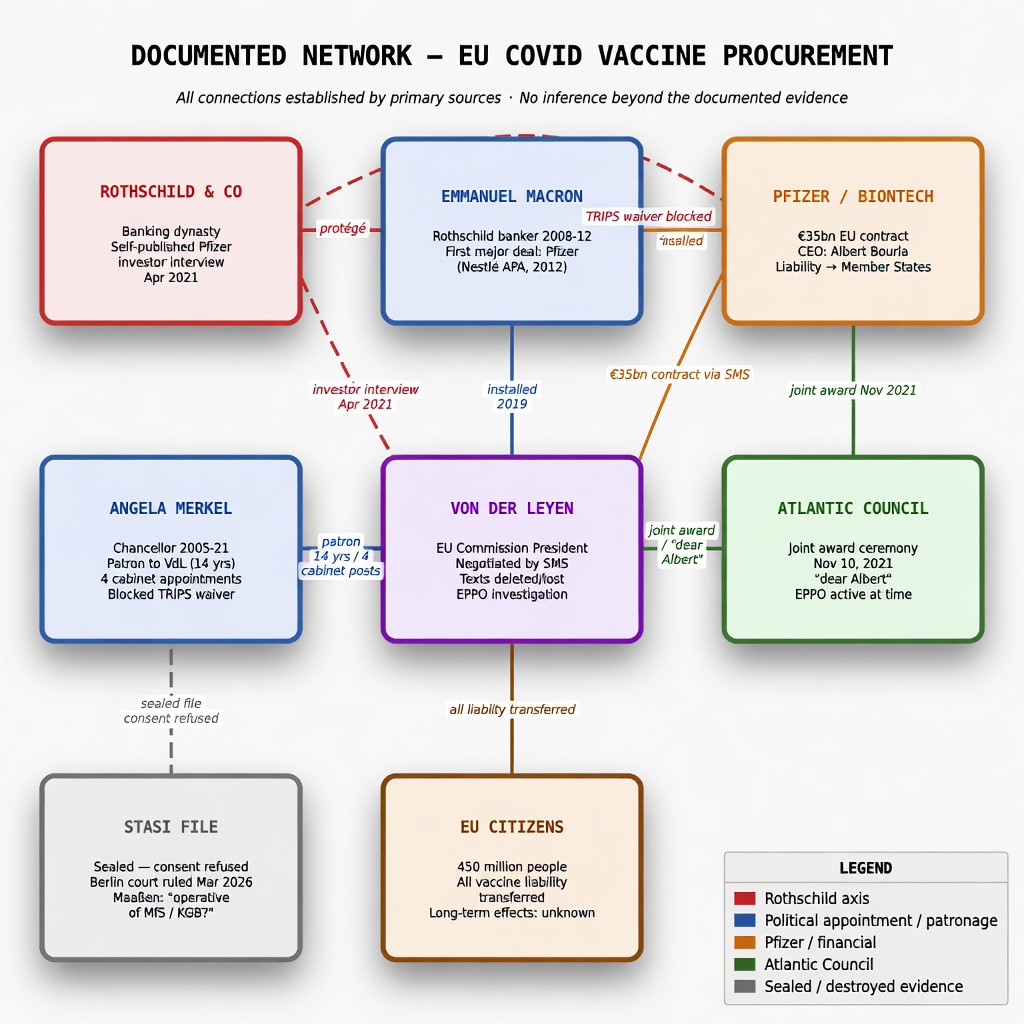
The documented network has two axes that converge on Von der Leyen:
- Axis 1 — Rothschild/Macron: Rothschild & Cie → Macron (protégé, Pfizer deal 2012) → Macron installs Von der Leyen (2019) → Von der Leyen negotiates €35bn Pfizer contract (2021). Simultaneously: Rothschild & Co publishes investor interview with Pfizer (April 2021).
- Axis 2 — Merkel: Merkel builds Von der Leyen across four cabinet appointments (2005–2019) → Merkel's blessing enables Von der Leyen's EU elevation → Merkel blocks TRIPS waiver protecting Pfizer IP (2021).
Von der Leyen is the hinge point. Macron provided the upward trajectory; Merkel provided the foundation and the policy cover. Both axes converge on the same corporate beneficiary: Pfizer, which received €35 billion in EU contracts negotiated off the record, with liability transferred to citizens, IP protected by a G7 veto, and the evidence of how it was arranged subsequently destroyed.
4.8 What This Network Means — In Human Terms
It is worth being direct about what this network produced for ordinary people, because the clinical language of procurement law and institutional analysis can obscure it.
A nurse in Frankfurt was told she would lose her job if she did not accept an injection. Her government had already signed a contract acknowledging the long-term effects of that injection were unknown — but that contract was redacted so she could not read it. The company that made the injection bore no legal liability if it harmed her — but that clause was redacted too. The regulator had confirmed that the injection would not prevent her from transmitting the virus to her patients — but vaccine passports and employment restrictions were justified on exactly that basis. The politician who negotiated the contract on her behalf was simultaneously being investigated for destroying the messages that would reveal what she had actually agreed. That investigation continues. That politician was re-elected.
A small business owner in Lyon was told he could not operate his restaurant unless his staff were vaccinated. France's President — who had built his career at Rothschild & Cie and whose first major deal there was for Pfizer — was the person most aggressively enforcing that requirement. He was not asked to disclose that professional history. He was not asked to recuse himself from pandemic policy. He remains President.
An elderly woman in Warsaw who could not travel to see her family was not told that her government had signed a contract acknowledging unknown long-term effects and transferring all liability to itself. She was not told that the restriction she faced was based on a transmission-prevention claim the regulator had never made. She was told the science was settled.
This is what the network produced. Not in theory. In fact. In the daily lives of real people across 27 countries.
The network does not require secret orders or conspiratorial meetings. It operates through something more durable: shared formation, shared interests, mutual protection, and the institutional confidence of people who have never faced meaningful accountability. Macron came from Rothschild. Von der Leyen came from Merkel. The contracts came from text messages. The text messages were destroyed. The investigation continues. The network remains in place.
Whether this constitutes criminal corruption is for prosecutors to determine. What it constitutes in democratic terms is a systematic, documented, and still-unremedied failure of every safeguard that was supposed to protect citizens from exactly this kind of capture.
5. The Contracts — What Was Hidden and Why
5.1 Structure
The European Commission, acting under Emergency Support Instrument (EU) 2016/369 as amended by Council Regulation (EU) 2020/521, concluded Advance Purchase Agreements (APAs) on behalf of all participating Member States. The formal signatory was Commissioner Stella Kyriakides. The actual negotiator, by her own admission to the New York Times, was Von der Leyen.
Under Article 7 of the framework agreement, participating Member States agreed not to negotiate separately with the same manufacturers — locking them into whatever terms the Commission had agreed.
5.2 What Was Redacted — and Why It Matters
The redactions were not random and not primarily about trade secrets. They followed a precise logic: everything that would have caused public outrage was hidden; everything that provided political legitimacy was left visible.
| Article | What Was Redacted | Why It Matters |
|---|---|---|
| Art. 1.7 | Price per dose — entire section redacted. The tiered structure (avg €15.50/dose) was completely hidden. | Citizens could not assess whether public money was responsibly spent or whether Pfizer received above-market rates from a captive buyer with no competitive tender. |
| Art. 1.8.1 | Advance payment — the €700 million upfront payment was hidden. Paid before a single dose was delivered. | Citizens' money was committed before authorisation was received. No public scrutiny was possible while the commitment was being made. |
| Art. 1.6.3 | Delivery schedule — dates and quarterly volumes redacted. | Citizens could not verify whether deliveries were on schedule or whether governments were accepting substandard performance without consequence. |
| Art. 1.6.9 | Storage temperature — the -75°C extreme cold chain requirement was redacted. | The true total cost of procurement was concealed. Citizens were not told of the extreme cold chain infrastructure their governments had committed to fund and maintain. |
| Art. 1.6.12 | Risk of loss — clause transferring all risk to Member States upon delivery was entirely redacted. | From the moment of delivery, all physical and financial risk transferred to governments. Citizens bore the loss of any spoilage, wastage, or unused doses without knowing this had been agreed. |
| Art. 1.12 | Indemnification — full liability transfer clause redacted. Pfizer indemnified against virtually all adverse outcomes. | Citizens could not know their governments had waived the right to sue Pfizer for harm caused by the vaccine. The manufacturer bore no accountability; citizens bore unlimited liability. |
| Art. 1.9 | Contact names — Janine Small (Pfizer relationship manager) and Nanette Cocero (signatory) were redacted. | Accountability requires knowing who signed and who managed the relationship. Anonymisation of corporate signatories is without precedent in public procurement. |
| Art. 1.8.3 | Bank account — the Citibank Dublin destination account for the €700M advance was redacted. | Public money was wired to an undisclosed account. Citizens had no means to verify the advance payment reached the intended recipient or remained within proper channels. |
| Art. II.15 | Amendment conditions (Moderna) — how and when the contract could be changed was redacted. | Oversight bodies could not assess whether subsequent modifications to pricing, liability, or delivery were authorised — or whether new obligations were imposed without parliamentary knowledge. |
The pattern: redactions fell into three categories — (1) price and financial commitments; (2) risk and liability transfer; (3) operational details revealing practical implications. What was left visible provided political legitimacy. What was hidden would have provoked opposition. These were political decisions enforced by confidentiality clauses written by private corporations against sovereign governments.
5.2a The Indemnification Architecture — What the Contract Actually Says
The indemnification clause is not a side provision. It is the architecture around which everything else in this contract is constructed. The redactions, the narrow fraud definition, the deleted text messages — all of it exists to protect what is written in Article 1.12. Read it carefully, because this is what your government signed on your behalf, before you were told, before the product was authorised, before a single dose was administered.
Article 1.12.1 — The Pre-Declaration
The contract opens the indemnification section not with a negotiated clause but with a declaration — made by the Commission on behalf of all 27 Member State governments:
"The Commission, on behalf of the Participating Member States, declares that the use of Vaccines produced under this APA will happen under epidemic conditions requiring such use, and that the administration of Vaccines will therefore be conducted under the sole responsibility of the Participating Member States."
Read that sentence again. A sovereign government pre-declared its own citizens solely responsible for harm from a product — before those citizens were told this had been agreed, before the product received regulatory authorisation, before a single dose was administered. The word "therefore" is doing enormous work. Because there is an epidemic, and because vaccination will happen, it follows — by declaration — that everything that results is the Member States' sole responsibility. Pfizer's responsibility: zero.
Article 1.12.3 — Wilful Misconduct: The Unreachable Standard
The only route by which Pfizer can lose its indemnification protection is if losses were caused by Wilful Misconduct. The contract defines this with precision:
"Wilful Misconduct shall mean: any wrongful act, willingly and knowingly committed, with the intent to cause harmful effects."
Intent to cause harmful effects must be proven. Not negligence. Not recklessness. Not concealment of known risks. Not suppression of safety data. Actual intent to harm. This standard has never been successfully established against a pharmaceutical company in litigation anywhere in the world. It was not chosen by accident. It was the ceiling below which everything Pfizer did — including submitting safety data to the FDA that the FDA sought to hide for 75 years — would remain legally protected.
Pfizer Runs Its Own Defence — At Your Government's Expense
When a citizen is harmed and brings a legal claim, Pfizer controls the legal defence. Pfizer chooses its own lawyers and directs the legal strategy. The legal costs are borne by the Member State. The citizen sues. Their government pays Pfizer's lawyers to fight them. This was agreed in the contract. It was redacted from the public version so that citizens could not read it.
Article 1.12.8 — The Protection Extends to the Entire Corporate Constellation
The indemnification does not protect only Pfizer. It extends to Pfizer's affiliates, sub-contractors, licensors, sub-licensees, and all officers, directors, employees and agents of each of them. Every company in the production chain, and every individual within them, is shielded from liability. Citizens and their governments have no legal recourse against any of them.
The Fraud Definition — Narrowed, Not Redacted
When the contract was publicly released, the entry for "Fraud" in the definitions section appeared to be redacted. The unredacted contract reveals something different: the fraud definition was not hidden. It was drafted. The full definition, from Article 1.2:
"'Fraud': an act or omission committed in order to make an unlawful gain for the perpetrator or another by causing a loss to the Union's financial interests, and relating to: i) the use or presentation of false, incorrect or incomplete statements or documents, which has as its effect the misappropriation or wrongful retention of funds or assets from the Union budget, ii) the non-disclosure of information in violation of a specific obligation, with the same effect or iii) the misapplication of such funds or assets for purposes other than those for which they were originally granted, it being understood that the Union's financial interests are impacted under this APA only by reason of the Advance Payment."
The critical words are at the end: the Union's financial interests are impacted under this contract only by reason of the Advance Payment — the €700 million paid before authorisation.
There are two ways to read this limiting clause. The first: fraud is legally actionable only in relation to the advance payment, meaning the other €34+ billion falls outside the contract's fraud definition entirely. The EU paid €35 billion, but fraud law, as written into this contract, covers only €700 million of it. The second reading: this is a technical accounting statement clarifying that the Commission's direct budget exposure flows only through the advance payment, with subsequent payments coming from Member States rather than from the Commission's own budget.
Either reading leads to the same practical place: fraud claims under this contract are legally confined to the advance payment. Whether that outcome was the intent or a convenient side effect of the drafting does not change what the clause does. The standard was agreed. It was agreed by lawyers representing 450 million citizens. Those lawyers accepted it.
5.2b The Moderna Contract — Primary Source Findings
The following findings are drawn directly from the unredacted Moderna Purchase Agreement (SANTE/2021/C3/010), signed 26 February 2021 (Moderna) and 4 March 2021 (Kyriakides). Where text is quoted verbatim, the OCR source is the unredacted contract file.
Indemnification: Interpreted Broadly in Favour of Moderna
Article II.5.1 of the Moderna contract establishes indemnification on explicitly broader terms than Pfizer's equivalent clause. The operative language, verbatim from the contract:
"The indemnification set forth herein (and in the Vaccine Order Form with each Participating Member State) is intended to be interpreted broadly in favor of indemnification and shall be available regardless of whether the Losses originate from Claims regarding testing, development, manufacture, delivery, export, import, distribution, sale, offer for sale, administration, use or deployment of the Product."
The scope is total. Every point in the chain from laboratory to patient is covered. No category of harm is excluded from the indemnification architecture. The only carve-out is Willful Misconduct or Gross Negligence — standards requiring proof of intent or recklessness that have never been successfully established against a pharmaceutical company in post-market litigation.
Liability Cap: 20 Percent — Lower Than Pfizer's 50 Percent
Article II.4.6 caps Moderna's maximum aggregate liability at 20 percent of amounts paid. Verbatim:
"Except as otherwise expressly set forth in this Article II.4.6, the contractor's maximum aggregate liability to the Commission or to a Participating Member State under or in connection with this APA or a Vaccine Order Form will not exceed the lesser of (a) (i) with respect to the Commission, twenty percent (20%) of the amount actually paid by the Commission to the contractor under this APA or (ii) with respect to the applicable Participating Member State, twenty percent (20%) of the amount actually paid by such Participating Member State to the contractor under this APA..."
By comparison, the Pfizer APA limits liability to 50 percent of the advance payment — already a negligible fraction of total contract value. Moderna's cap, at 20 percent of amounts actually paid, is structurally similar but numerically lower. Both are trivial relative to the total value transferred and the scale of potential harm.
Manufacturing Partners: Lonza AG and Rovi Pharma — Named in Annex V
Annex V of the unredacted contract lists the confirmed manufacturing network partners with full legal identities and addresses. Both were redacted from the public version. Verbatim from the contract:
"Lonza AG — MUNCHENSTEINERSTRASSE 38, 4002 BASEL, SWITZERLAND / LONZASTRASSE, 3930 VISP, SWITZERLAND — Manufacturing and releasing of final drug substance."
"Rovi Pharma Industrial Services SAU — VIA COMPLUTENSE 140, 28805 ALCALA DE HENARES, SPAIN / PASEO DE EUROPA 50, SAN SEBASTIAN DE LOS REYES, 28703 MADRID, SPAIN — Filling, packaging, labeling and releasing of final drug product."
Both manufacturing partners were funded substantially by the advance payment. The advance payment to Moderna — €318,471,338 (equivalent to approximately $360 million at 2020 exchange rates) — was payable within 15 days of signature. Citizens' money financed production capacity at private facilities whose identities were redacted from the publicly released contract.
Annex VI: Safety, Efficacy, and Duration "Currently Being Evaluated"
Annex VI of the unredacted Moderna contract is titled "Preliminary Specifications of the Product." It contains the following verbatim admissions, each pertaining to the product being purchased for mass administration:
"Safety/Reactogenicity: The safety of the vaccine is currently being evaluated in clinical trials."
"Measures of Efficacy: The efficacy of the vaccine is currently being evaluated in clinical trials."
"Durability of protection: The durability of protection of the vaccine is currently being evaluated in clinical trials."
These statements appear in the contract's own technical annex — the document describing what, precisely, was being purchased. At the time of signing, December 2020 through March 2021, safety, efficacy, and duration of protection were all, by Moderna's own contractual admission, matters still under investigation. The product was being purchased — and its administration was being planned — on this basis.
Source: Moderna Purchase Agreement SANTE/2021/C3/010 (unredacted), Annex V and Annex VI; advance payment figures from Art. I.4.2.
5.2c The Sovereign Immunity Waiver — Pfizer Art. II.6.6
Article II.6.6 of the Pfizer APA is titled "Waiver of sovereign immunity." It requires each Member State government to make a binding representation — in writing, as a contractual term — about its own financial capacity to meet unlimited indemnification claims. Verbatim from the unredacted contract:
"Each Participating Member State represents that it has adequate statutory or regulatory authority and adequate funding appropriation to undertake and completely fulfil the indemnification obligations pursuant to Article 1.12 of this APA."
Read the structure carefully. The indemnification obligation under Article 1.12 has no ceiling in terms of harm covered. It includes death, physical injury, mental and emotional injury, illness, disability, property loss, and economic losses — for any person harmed, directly or indirectly, through any stage of the vaccine's lifecycle. Article II.6.6 then requires each government to represent that it has "adequate funding appropriation to completely fulfil" those obligations.
This is not a procedural formality. It is a contractual statement by sovereign governments that their national treasuries stand behind unlimited indemnification claims. If the costs of harm exceed any national budget line, that is not Pfizer's problem. The representation was made. The contract was signed. The clause was redacted from the public version.
Citizens of 27 Member States were not told their governments had made this representation. They were not told their governments had effectively pledged national treasury capacity to cover any and all harm from a product whose safety profile was, by the contract's own annex, still being evaluated.
Source: Pfizer APA SANTE/2020/C3/043 (unredacted), Art. II.6.6, confirmed by OCR of Part 2.
5.2d Order Form Article 4 — What Every Government Signed
The Vaccine Order Form is the operative document each individual Member State signed to place its order for doses. It incorporates the APA by reference. Article 4 of the Order Form contains the acknowledgment that goes to the heart of what citizens were not told. Verbatim from the unredacted contract:
"The Participating Member State acknowledges that the Vaccine and materials related to the Vaccine, and their components and constituent materials are being rapidly developed due to the emergency circumstances of the COVID-19 pandemic and will continue to be studied after provision of the Vaccine to the Participating Member States under the APA. The Participating Member State further acknowledges that the long-term effects and efficacy of the Vaccine are not currently known and that there may be adverse effects of the Vaccine that are not currently known."
Every government that ordered doses — all 27 — signed this text. The signature was not on a technical annex buried in procurement files. It was on the operative order document. The legal acknowledgment is unambiguous: long-term effects unknown, adverse effects unknown.
During the same period, government communications across Europe told citizens the vaccines were safe and effective. Official messaging did not say "safety is currently being evaluated." It did not say "long-term effects are not currently known." It said the vaccines had been rigorously tested and were safe for the population.
The distance between what governments signed in private and what they said in public is the central accountability question this document raises. The contracts are now public. The public communications are on record. The gap between them is documented.
Source: Pfizer APA SANTE/2020/C3/043 (unredacted), Annex I Model Vaccine Order Form, Article 4; confirmed by OCR of Part 2, page 18-19.
5.3 Pfizer/BioNTech APA — Price Structure
| Volume Tier | Price Per Dose (excl. VAT) |
|---|---|
| Doses 1–100 million | €17.50 |
| Doses 101–200 million | €13.50 |
| Average (200M doses) | €15.50 |
| Additional order (≤3 months post-authorisation) | €15.50 |
| Additional order (thereafter) | €17.50 |
Advance Payment: €700 million (€3.50 × 200M doses), payable within 20 business days of signing — before any doses were delivered, before authorisation was received. Paid to Pfizer Inc. EUR Account, Citibank Dublin, Ireland.
5.4 Liability Transfer
Both contracts transferred all liability for adverse events from the manufacturers to the Member States and ultimately to citizens. The companies were indemnified for any liability arising from the use and deployment of the vaccines. This provision was redacted from the publicly released versions.
5.5 Intellectual Property
Both contracts grant Pfizer and Moderna sole ownership of all intellectual property generated during development — IP substantially funded by EU taxpayers through advance payments. This connects directly to Merkel's blocking of the TRIPS waiver, which would have permitted other manufacturers to produce vaccines using that IP without licensing restrictions.
6. Safety Data — What Was Known and When
6.1 Post-Marketing Adverse Events (Pfizer 5.3.6)
Within 90 days of the vaccine rollout, Pfizer had compiled an internal post-marketing surveillance report that identified 1,291 adverse event categories of special interest across 42,086 case reports. This document — known as the 5.3.6 report — was submitted to the FDA as part of the ongoing regulatory process.
The FDA's response was to ask that the document be kept from public view for 75 years. Not five years. Not ten. Seventy-five. A federal court disagreed and ordered earlier disclosure. The document is now public.
Read that again in human terms: within three months of mass rollout, Pfizer's own surveillance had generated over 42,000 case reports spanning nearly 1,300 categories of adverse events — and the regulatory agency that is supposed to protect the public asked for that information to be suppressed until everyone currently alive is dead.
During that same period, the governments of 27 EU Member States were publicly telling their citizens that the vaccines were safe and effective. Those same governments had already signed contracts indemnifying Pfizer against liability for exactly the adverse events now being catalogued. Citizens had no access to the 5.3.6 data. They had no legal recourse under the contracts. They had no way of knowing that the product being recommended — and in practice compelled — had already generated a safety signal that the manufacturer and regulator had agreed to hide.
Source: Pfizer document 5.3.6 — Post-Marketing Experience (project file: 5_3_6postmarketingexperience.pdf)
6.2 Occupational Safety — Comirnaty Sicherheitsdatenblatt
The Comirnaty occupational safety datasheet classifies the active mRNA substance BNT162b2 at OEB5 — the highest possible occupational hazard band. The datasheet describes its toxicological properties as 'not thoroughly investigated.' Required protections for anyone handling it included respiratory protection, full impermeable body clothing, double nitrile gloves, and eye protection. These requirements applied to every healthcare worker drawing this substance into a syringe across Europe. None of them were given this information. Official download links were redacted. When the German Federal Ministry of Health formally requested the datasheet from BioNTech, BioNTech could not produce it. The document was not archived online until December 2022 — after hundreds of millions of doses had been administered.
This document was not proactively distributed to administering healthcare workers as required by workplace safety law. Links from which it could be downloaded were redacted. BioNTech appeared unable to locate the document promptly when requested by the German Federal Ministry of Health.
Source: Pfizer-BioNTech Sicherheitsdatenblatt (Safety Data Sheet), Version 2.01, 13 May 2022 (project file); German Federal Ministry of Health correspondence (project file)
6.3 EMA Confirmation on Transmission
In October 2023, the European Medicines Agency responded in writing to MEPs Marcel de Graaff, Gilbert Collard, Francesca Donato, Joachim Kuhs, Mislav Kolakušić, Virginie Joron, Ivan Vilibor Sinčić and Bernhard Zimniok, confirming that COVID-19 vaccines 'have not been authorised for preventing transmission from one person to another.' The authorised indication is protection of the vaccinated individual only.
Transmission prevention was the stated justification for vaccine passports and access restrictions that functionally compelled vaccination across Europe without formal mandate. The EMA's confirmation means those restrictions lacked the scientific foundation on which they were publicly justified.
Source: EMA letter to MEP Marcel de Graaff et al., 18 October 2023, EMA/451828/2023 (project file: 2023_10_18_Letter_to_MEP_Marcel_de_Graaff_Request_for_the_direct.pdf)
7. Compulsion Without Mandate
Formal vaccine mandates were rejected by democratic processes in Germany — the Bundestag voted against compulsory vaccination on 7 April 2022 (primary proposal defeated 378–296). The same outcome was avoided or circumvented across Europe through a consistent mechanism: access restrictions implemented by executive action, without the same parliamentary scrutiny that formal mandates would have required.
Germany's tiered access restriction system (2G/3G rules):
| Rule | Who Qualified | Where Applied |
|---|---|---|
| 3G | Vaccinated, recovered, or tested | Workplaces and public transport |
| 2G | Vaccinated or recovered only — NO test alternative | Bars, restaurants, cinemas, museums, events |
| 2G+ | Vaccinated/recovered + PCR test | High-incidence states and settings |
The 3G rule applied to workplaces and public transport — neither optional for most working people. The 2G rule excluded the unvaccinated entirely, even with a negative test showing they posed no viral risk. These were not laws passed by parliament. They were executive ordinances implemented at federal-state level, precisely because a formal mandate had been put to parliament and parliament had said no. The democratic process produced one answer. The executive process produced the same practical result through different means.
Think about what that meant for individual people. A teacher in Bavaria who had recovered from COVID and had demonstrable natural immunity could not enter her school under 2G rules without vaccination. A bus driver in Hamburg who declined on conscientious grounds lost the right to use public transport and, effectively, his ability to work. A student in Munich was excluded from university libraries and lecture halls. None of these exclusions were based on evidence that the vaccine prevented transmission — the EMA had never said it did. They were based on political pressure, compliance with an agenda, and the bureaucratic momentum of a system that had decided what it wanted and arranged the rules to get there.
People lost jobs, income, and relationships. Some lost businesses they had built over decades. Some faced social ostracism from families and communities. All of this happened on the basis of a false premise — transmission prevention — while the contracts that transferred all liability for any harm to those same people were hidden from view.
And when the German parliament was finally given the explicit choice — should we make this compulsory? — it said no. 378 to 296. The democratic answer was no. The practical answer, through the access restriction system, was already yes.
8. Source Attribution — Complete and Corrected
All major claims in this document are attributed below with correct sources. Earlier research sessions contained citation index errors (specifically: material about the Merkel/Von der Leyen relationship was incorrectly attributed to the Rothschild & Co website; that website contains only the investor interview with Pfizer). Those errors are corrected here.
| Claim | Source | URL / Reference |
|---|---|---|
| Merkel placed trust in VdL as unproven politician | Foreign Policy, 30 April 2021 | foreignpolicy.com — "The Aristocratic Ineptitude..." |
| VdL "loyal confidante" of Merkel; likely successor | France 24, 1 December 2019 | france24.com — "Merkel loyalist, favoured by Macron" |
| VdL only minister in all four Merkel cabinets | France 24 (2019); Wikipedia | en.wikipedia.org/wiki/Ursula_von_der_Leyen |
| 2018 reappointment as sign of Merkel confidence | CDU official biography | kas.de — CDU Geschichte |
| Macron as Rothschild protégé; FT description | Financial Times (2018); Factually.co | factually.co/fact-checks/politics/macron-rothschild-connections |
| Macron's Pfizer deal at Rothschild (Nestlé APA) | Money.com; Wikipedia | money.com/emmanuel-macron-french-president-wealth-net-worth-rich |
| Rothschild & Co investor interview with Pfizer [self-published] | Rothschild & Co own website, April 2021 | rothschildandco.com — "Investment Views: An interview with Pfizer" |
| Merkel blocking TRIPS waiver | Human Rights Watch, 14 June 2021 | hrw.org — "Merkel should steer EU COVID-19 IP waiver" |
| Atlantic Council ceremony — VdL and Bourla | WorldNews, 17 November 2021 | article.wn.com — Atlantic Council ceremony |
| EMA: vaccines not authorised for transmission | EMA letter to MEP Marcel de Graaff, 18 October 2023 | Project file: 2023_10_18_Letter_to_MEP_Marcel_de_Graaff...pdf |
| Pfizer 1,291 adverse event categories in 90 days | Pfizer 5.3.6 post-marketing report | Project file: 5_3_6postmarketingexperience.pdf |
| EPPO investigation of VdL | EPPO public statements; mainstream press | Multiple outlets, 2022–2024; EPPO website |
9. Merkel, the Stasi, and the Sealed File
A parallel accountability problem exists regarding Merkel's past in the German Democratic Republic — one that follows the same structural pattern as Von der Leyen's deleted text messages: the person with most to lose controls whether the evidence is seen.
9.1 Maaßen's Statement — January 2025
In January 2025, Hans-Georg Maaßen — former President of Germany's domestic intelligence service (Verfassungsschutz), who was himself dismissed by Merkel — made the following public statement:
"The release of Ms. Merkel's Stasi file is necessary in the interest of democracy, because citizens have a right to know whether they have been governed by a former operative of the Stasi and/or the KGB. If she had merely been a low-level employee of an administrative agency, her file would have had to be released long ago."
Maaßen's statement carries particular weight: he held the highest domestic intelligence position in Germany and was dismissed by Merkel — giving him both institutional expertise and personal standing. His phrasing implies the file should have been released automatically if it were merely an administrative victim file — suggesting he has reason to believe it is not.
Source: Hans-Georg Maaßen public statement, January 2025. Facebook post (verified); confirmed by Journalistenwatch (January 31, 2025) and Philosophia Perennis (February 3, 2025).
9.2 The Legal Battle and the March 2026 Ruling
Marcel Luthe — founder of the Good Governance Gewerkschaft and former FDP member of the Berlin parliament — brought a lawsuit before the Berlin Administrative Court to force release of Merkel's Stasi file, arguing that as a historical public figure and former Chancellor, her file falls within mandatory disclosure provisions of the Stasi Records Act.
On March 13, 2026, the court ruled against him. The First Chamber, presided over by Judge Jens Tegtmeier, found that Luthe had "no legal claim to the release" under the Stasi Records Act. Luthe was ordered to pay €20,000 in accumulated legal costs. The file remains sealed.
The legal mechanism: the Federal Archive classifies Merkel's possible file as a non-perpetrator file — meaning a file collecting information about her, rather than documenting her as a Stasi operative. This triggers personal data protection. Without Merkel's own consent, the file cannot be released. Merkel refuses to consent.
The structural problem: the classification as victim vs. perpetrator file is itself the question at issue. Whether Merkel was an informant or merely surveilled cannot be determined without seeing the file. But the file cannot be seen unless the question is already resolved in her favour. The court accepted the circular logic. The Berlin Administrative Court also delayed hearing the case for over a year before ruling.
Berliner Zeitung, March 13, 2026; Full legal analysis, March 15, 2026
9.3 Documented Anomalies from Merkel's DDR Years
The following facts about Merkel's DDR biography are documented and uncontested. They do not prove Stasi collaboration — but they constitute an unusual pattern that the sealed file would either explain or refute:
- She was permitted to travel to West Germany multiple times without family members being held as hostages — the standard DDR practice for controlling citizens with Western contacts.
- She made foreign trips to the Soviet Union, Poland, and Czechoslovakia — unusual for DDR citizens at her professional level.
- At least three colleagues at her institute (the Central Institute for Physical Chemistry, Academy of Sciences) were registered Inoffizielle Mitarbeiter (unofficial Stasi collaborators).
- Her later political patron Lothar de Maizière — who gave her her first political role in 1990 — was subsequently identified as Stasi IM "Czerny."
- She held the position of Secretary for Agitation and Propaganda in the FDJ leadership of her institute — a role requiring ideological reliability and involving reporting on colleagues.
- Despite documented infractions including smuggling Solidarność materials and making an illegal trip to the Soviet Union, she faced no disciplinary consequences — highly unusual in the DDR system.
Journalistenwatch, September 27, 2025; Hubertus Knabe research (Berlin-Hohenschönhausen Memorial); Kettner Edelmetalle analysis, May 12, 2025
9.4 What Is and Is Not Established
What is not proven: that Merkel was Stasi IM "Erika" or any registered informant. Historian Hubertus Knabe — former director of the Hohenschönhausen Memorial and Germany's leading Stasi researcher — found traces of an unofficial collaborator with that codename but concluded: "There is no evidence whatsoever for the claim that Chancellor Merkel worked for the Stasi under the codename 'Erika.' If a corresponding IM file had existed, traces of it should still remain — and that is not the case based on current knowledge."
What is established: Merkel enjoyed privileges in the DDR inconsistent with her official status. Her immediate professional environment was heavily surveilled and infiltrated. Her first political patron was a confirmed Stasi informant. Her file exists. She refuses to release it. The court accepted her refusal. The case was delayed for over a year before a ruling was made against the plaintiff.
9.5 The Structural Pattern
The parallel with Von der Leyen's deleted text messages is exact in form:
- Von der Leyen: communications that would reveal who instructed the Pfizer deal were destroyed. The person whose conduct is in question controlled the evidence.
- Merkel: documents that would reveal her DDR intelligence relationships are sealed. The person whose conduct is in question controls consent to release.
- In both cases, the institutional system that would compel disclosure is the same system that accepted the explanation for why disclosure cannot happen.
A Chancellor who governed Germany for 16 years, who dismissed her own domestic intelligence chief, and who has blocked release of her own intelligence file has successfully prevented any independent verification of her past. The March 2026 ruling confirmed that the legal system will not compel that verification.
10. Summary Findings
The following are established beyond reasonable dispute by primary source documentation:
- Von der Leyen personally conducted vaccine procurement through private communications with Pfizer's CEO. Those communications have been destroyed or declared lost. The EU General Court found this explanation implausible.
- Von der Leyen was installed through a backroom deal engineered by Macron — a former Rothschild banker whose first major deal was for Pfizer, described as a Rothschild protégé.
- Rothschild & Co simultaneously published their own investor relationship with Pfizer on their own website — self-generated primary evidence of proximity to the corporate beneficiary of the contracts their protégé had installed the Commission President to negotiate.
- Von der Leyen's 14-year political patron Merkel simultaneously blocked the TRIPS waiver protecting pharmaceutical IP monopolies globally — the same monopolies guaranteed in the contracts.
- Von der Leyen's husband's pharmaceutical appointment was undisclosed during the procurement period.
- Both contracts transferred all liability to citizens while companies retained IP funded by public money.
- Member States explicitly acknowledged unknown long-term effects in signed contracts while telling citizens the opposite.
- Pfizer's 1,291 adverse event categories identified within 90 days were sought to be withheld for 75 years.
- The EMA confirmed in writing that vaccines were not authorised to prevent transmission — the stated justification for access restrictions used to functionally compel vaccination.
- Formal mandates were democratically rejected. Near-equivalent compulsion was implemented by executive action, bypassing the same parliamentary scrutiny.
- No principal actor faces criminal charges. Von der Leyen was re-elected Commission President in July 2024.
Methodological Note
Primary source documents referenced in this report — including the unredacted Pfizer and Moderna Advance Purchase Agreements, the Pfizer 5.3.6 post-marketing adverse event report, the Comirnaty occupational safety datasheet, and EMA correspondence with MEPs — are available on request from R. Leland Lehrman, independent researcher and steward of this document: lelandlehrman@protonmail.com
This report is based on primary source documents including the unredacted Pfizer and Moderna APAs, Pfizer's post-marketing adverse event data (5.3.6), the Comirnaty occupational safety datasheet, the EMA letter to MEPs (October 2023), and verified published reporting from the Financial Times, New York Times, Foreign Policy, France 24, Human Rights Watch, Wikipedia, and Rothschild & Co's own published materials. All factual claims about individuals are drawn from verified sources cited inline. The EPPO investigation is ongoing; no criminal findings have been made. Source attribution has been reviewed and corrected in this version.